Surprise Freebie in Every Order

The 19-Year-Old Who Argued and Won His Case in the Supreme Court: A New "Court Hero
19-year-old student recently did the unthinkable
Bling Blossom
2/14/20262 min read
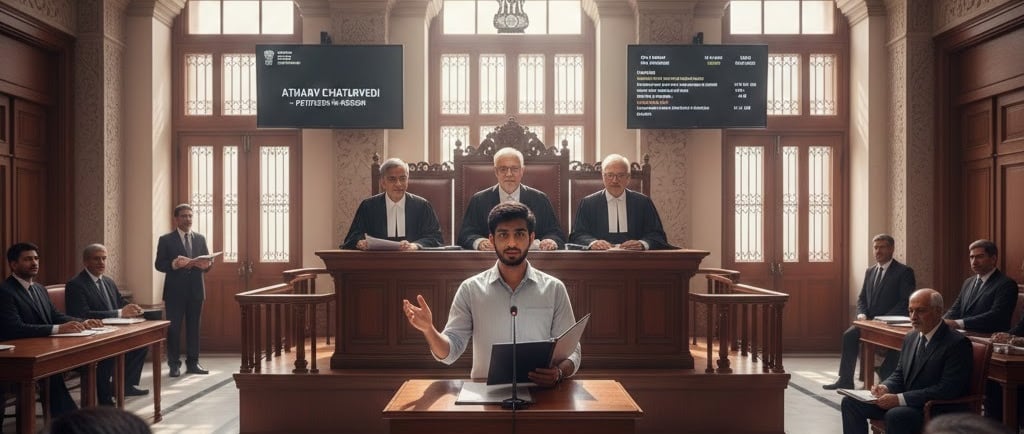
In the hallowed halls of the Supreme Court of India, where seasoned legal giants in black robes debate the nuances of the Constitution, a 19-year-old student recently did the unthinkable. Without a law degree, without a senior advocate by his side, and armed only with 10 minutes of permitted time, Atharv Chaturvedi stood his ground and won a life-altering victory.
Today, he is being hailed as India’s "Court Hero." But behind the viral headlines is a story of grit, systemic failure, and a young man who refused to let bureaucracy kill his dream of becoming a doctor.
The Struggle: A Merit-Holder Without a Seat
Atharv Chaturvedi, a resident of Jabalpur, Madhya Pradesh, is no stranger to hard work. He cleared the NEET (National Eligibility cum Entrance Test) not once, but twice. Despite scoring a solid 530/720 and holding a high rank in the Economically Weaker Section (EWS) category, he was repeatedly denied an MBBS seat in private medical colleges.
The reason? A frustrating policy gap. While government colleges in Madhya Pradesh implemented the 10% EWS reservation, private colleges had failed to do so, claiming they hadn't "enhanced" their seat capacity yet.
From High Court Rejection to Supreme Court "In-Person"
Atharv first took his fight to the Madhya Pradesh High Court. The court acknowledged his struggle but ultimately dismissed his petition, even suggesting that with his argumentative skills, he "should have been a lawyer."
Taking that "compliment" as a mission, Atharv didn't give up. He filed a Special Leave Petition (SLP) in the Supreme Court. On February 10, 2026, appearing via video link as a Petitioner-in-Person, he made a humble request to the bench: "I only need 10 minutes to explain my case."
The Turning Point: Article 142
The bench, led by Chief Justice Surya Kant, was impressed by the young student's ability to highlight the "patently unfair" disadvantage he faced.
In a landmark move, the Supreme Court invoked Article 142 of the Constitution. For those unfamiliar, Article 142 allows the Supreme Court to pass any order necessary to do "complete justice" when existing laws or administrative delays fall short.
The Court’s Verdict:
Immediate Admission: The National Medical Commission (NMC) and the MP Government were ordered to grant Atharv an MBBS seat in a private college within 7 days.
Zero Delay Tolerance: The court rebuked the authorities, stating that bureaucratic delays cannot be allowed to ruin a meritorious student's career.
Why This Matters for India
Atharv’s victory isn't just about one MBBS seat. It is a massive win for:
EWS Candidates: It sets a precedent that private institutions cannot dodge reservation policies indefinitely.
Common Citizens: It proves that the doors of the highest court are open even to those who cannot afford expensive legal teams.
The Youth: It serves as a reminder that if you are right, you should stand your ground, regardless of how big your "opponent" is.
Final Thoughts
Atharv Chaturvedi wanted to be a doctor to save lives; in the process, he ended up saving the future of the EWS reservation policy in private education. As he prepares to finally enter a medical classroom, he leaves behind a legacy in a courtroom—a reminder that in India, merit and justice can still win, provided you have the courage to speak up.
Bling Blossom
Explore our sleek website for seamless navigation.
Contact
Newsletter
info@blingblossom.com
0091-7982840300
© 2026. All rights reserved.